Plate 07 Guide
Fractal art and photography: mixing natural and computed patterns
Photographers look for fractal patterns in the world, and fractal artists borrow from photographs. This guide covers both directions and how to label the result honestly.
Where fractals show up in photographs
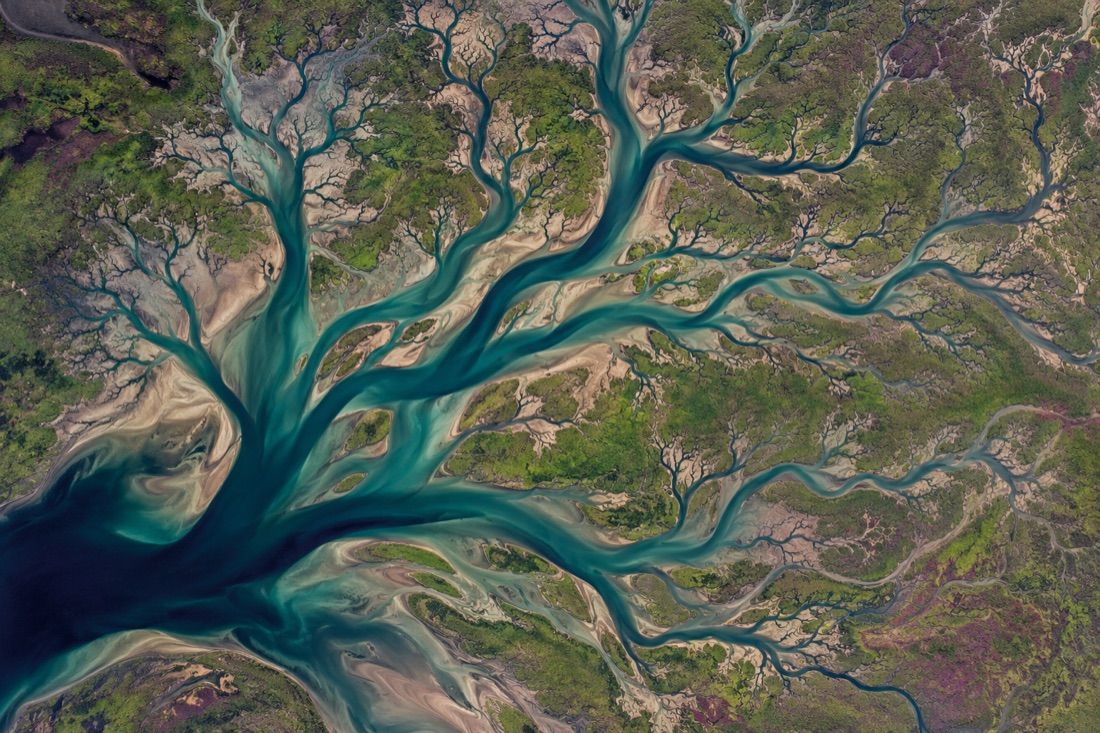
Branching and repetition appear all over nature: ferns, Romanesco cauliflower, tree crowns, river deltas, lightning, frost and coastlines. These are statistical, not exact. Benoit Mandelbrot argued the point in his 1967 paper on the length of the coast of Britain, which showed that a measured coastline gets longer the finer the ruler you use. A real coast looks rough at many scales, but only within a limited range.
Photographing fractal patterns
Look for repetition at several sizes in one frame: a fern frond in macro, a river network from a high viewpoint, bare branches against the sky. Choose a viewpoint where the pattern fills the frame, use a small aperture for depth when you are close, and shoot in soft light so the detail is not buried in harsh shadow. A pattern that looks fractal at one scale can be photographed again at another.
Fractal renders as layers
To combine a computed fractal with a photograph, render the fractal large and export a lossless file, then place it as a layer above the photograph in an editor. Blend modes decide the result: Screen and Add brighten, Overlay and Soft Light add contrast and colour, Multiply darkens. A layer mask lets the fractal show only in the sky, or only around a subject. Keep the effect subtle if you want the photograph to remain the main subject.
Colours taken from a photograph
A simple and effective approach is to sample colours from a photograph and build a gradient from them, then colour a fractal with that gradient. The finished picture shares a mood with the photograph even if the shapes are unrelated. Some programs can also use an image as a background or a colour source, so check the manual of your fractal software.
Glass fractal filters are a different thing
Photographers also sell and discuss prisms and glass filters described as fractal. These are optical effects that make repeated or kaleidoscope like copies of the scene in front of the lens. They are not computed fractals and they do not follow a formula, though the results can resemble repetition at several scales.
Be clear about what is what
If you show or sell a combined image, say that it combines a photograph and a rendered fractal. Use only photographs you took or have permission to use. When you are ready to print, giclee vs regular print explains the options, and what is fractal art gives the wider background.