Plate 01 Guide
What is fractal art? How a rule becomes a picture
Fractal art is made by calculating a mathematical object and turning the result into an image. This guide explains the idea without assuming any maths beyond school level.
Short answer
Fractal art is a form of algorithmic art. A program repeats a simple rule many times, often millions of times, and the results are mapped to colour and saved as a still image, an animation or a print. The artist chooses the formula, the place to look at, the colours and the final crop. The computer does the arithmetic.
Nothing in the definition requires a particular program or style. A glowing spiral from the Mandelbrot set, a swirl of light from a fractal flame and a three dimensional rock formation from a 3D renderer all count.
Where the word fractal comes from
The mathematician Benoit Mandelbrot introduced the word in 1975. He took it from the Latin fractus, meaning broken, to describe shapes that are rough or fragmented at every scale instead of smooth like a circle. Mathematicians had studied such shapes earlier, but the new word and the arrival of computer graphics in the 1980s made them easy to look at.
Self similarity in plain terms
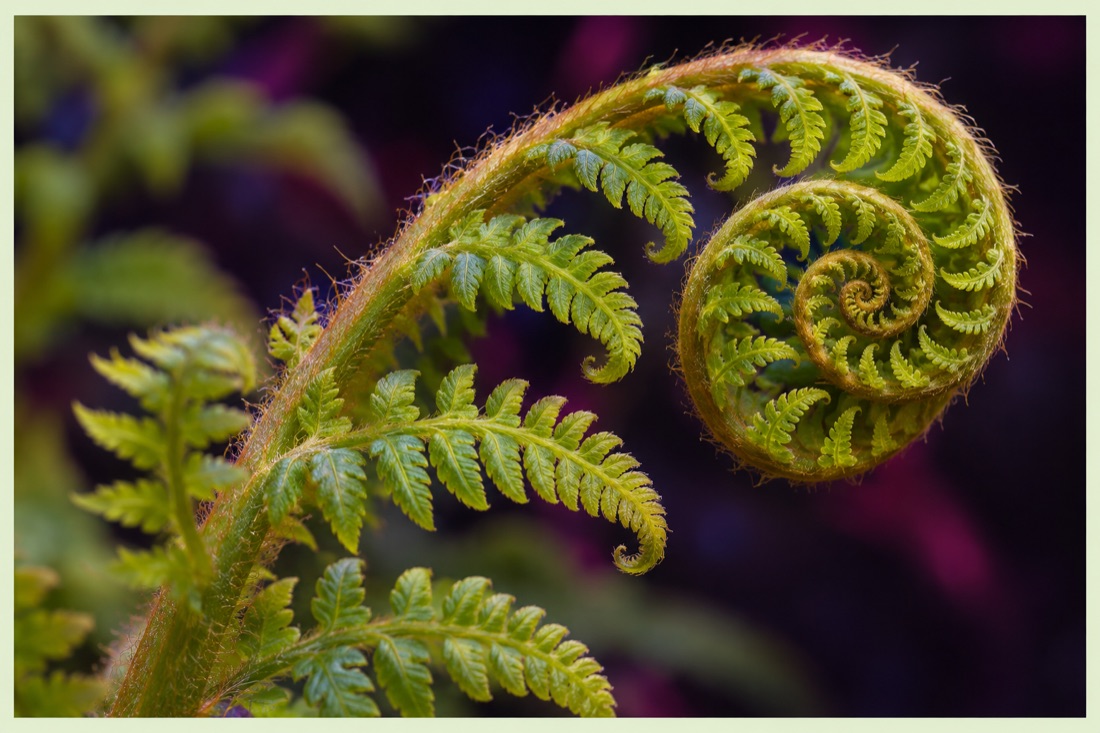
Many fractals are self similar: a small piece looks like the whole, or like a close relative of it. Zoom into a fern leaf and you see leaflets arranged like the leaf. The comparison is useful but loose. A mathematical fractal repeats forever, while a real fern repeats only a few times and only statistically. That difference matters when you read about fractals in nature, which is covered in fractal art and photography.
Families of fractals used in art
Sources group fractals in slightly different ways. A common grouping for art tools looks like this:
- Escape time fractals. Each pixel runs a formula until its value escapes or the program gives up. The Mandelbrot set and Julia sets belong here.
- Iterated function systems. A few rules are applied again and again to a point. The Sierpinski triangle and the Barnsley fern are classic examples, and fractal flames extend the idea.
- L-systems. Text rewriting rules draw branching plants and curves.
- Strange attractors. A system of equations traces a looping, never repeating path.
- 3D fractals. Escape time ideas extended into space, such as the Mandelbulb.
Famous examples
The Mandelbrot set is the picture most people mean when they say fractal. The Koch snowflake, described by Helge von Koch in 1904, and the Sierpinski triangle, described by Waclaw Sierpinski in 1915, are older and simpler. Julia sets carry the name of Gaston Julia, who published his study of iterated functions in 1918.
What makes it art and not just maths
A plot of a formula is a diagram. Fractal art starts when somebody makes choices: which region is worth rendering, how many iterations reveal the filaments, which gradient shows the structure, how to crop and finish the picture. Two people can open the same formula and make unrelated pictures, which is why how to make fractal art is mostly a guide to decisions.
Is fractal art the same as AI art
No. A fractal is deterministic: the same formula, location and settings always produce the same image. There is no training data and no prompt. Image generators work in a different way and can be asked to imitate the look of fractals, but the result is a picture of a style rather than the product of the formula.